Standing Asanas
Building Stability, Strength and Grounding
Standing asanas are the foundation of physical yoga practice. They strengthen the legs and core, improve posture, and develop balance and focus. For beginners and advanced practitioners alike, these postures create a sense of grounding and inner stability that supports all other asanas.
Standing postures are especially important for:
- Improving alignment of the spine, hips and knees
- Developing leg strength and joint stability
- Enhancing balance, coordination and concentration
- Preparing the body for more advanced asanas and pranayama
General Guidelines for Standing Asanas
- Practice on a stable, non-slippery surface.
- Keep the feet active and grounded, toes spread, weight evenly distributed.
- Maintain a long, neutral spine – avoid collapsing in the lower back or rounding the shoulders.
- Breathe smoothly and steadily; do not hold the breath.
- If you feel sharp pain in knees, lower back or neck, come out of the pose slowly and modify.
Major Standing Asanas Taught at Nirog Yoga University
1. Tāḍāsana (Mountain Pose)
Purpose: Base pose for all standing asanas.Key points:- Feet hip-width or together, weight evenly on both feet
- Thighs gently engaged, tailbone lengthening down
- Chest open, shoulders relaxed, chin parallel to floor
- Awareness of grounding through feet and length through spine
Improves posture, body awareness and alignment.
2. Vīrabhadrāsana I (Warrior I)
Purpose: Strength, stamina and focus.Key points:- Front knee bent above ankle, back leg straight and strong
- Hips turning towards the front as far as is comfortable
- Arms lifted overhead, palms facing each other, shoulders relaxed
- Gaze softly forward or slightly upward
Strengthens legs, opens hips and chest, builds confidence.
3. Vīrabhadrāsana II (Warrior II)
Purpose: Stability and concentration.Key points:- Wide stance, front knee bent, back leg firm
- Hips and chest open to the side
- Arms extended in one line, shoulders relaxed
- Gaze over front fingertips
Strengthens thighs and shoulders, improves endurance and mental focus.
4. Utthita Trikoṇāsana (Extended Triangle Pose)
Purpose: Lateral stretch and spinal alignment.Key points:- Feet wide apart, front foot turned out, back foot slightly in
- Front hand to shin/block, back arm reaching up
- Both sides of waist long, chest rotating open
- Gaze up, sideways or down according to neck comfort
Stretches hamstrings and hips, opens chest, improves balance.
5. Utthita Pārśvakonāsana (Extended Side Angle Pose)
Purpose: Deep side stretch and strength.Key points:- From Warrior II, front forearm to thigh or hand to block/floor
- Top arm extended over ear, creating a long diagonal line
- Front knee stays aligned over ankle
- Chest rotating upward, breath deep into side ribs
Strengthens legs and core, stretches side body and groin.
6. Ardha Chandrāsana (Half Moon Pose)
Purpose: Dynamic balance and core activation.Key points:- From Triangle, front hand on floor/block slightly ahead of foot
- Back leg lifted parallel to floor, foot active
- Top arm reaching up, chest turning open
- Gaze down (beginner), sideways or up (advanced)
Improves balance, strengthens ankles, legs and core.
7. Vṛkṣāsana (Tree Pose)
Purpose: Balance and focus.Key points:- Stand tall in Tadasana
- Place sole of one foot on opposite ankle, calf or inner thigh (avoid knee joint)
- Hands in prayer at chest or raised overhead
- Gaze at a still point in front (drishti)
Strengthens ankles, knees and hips; trains concentration and steadiness.
8. Parśvottānāsana (Pyramid Pose)
Purpose: Hamstring stretch and forward bend with stability.Key points:- Feet in narrow standing stance, both legs straight
- Hips squared to the front as far as possible
- Spine long as you fold over the front leg
- Hands on blocks, floor or in reverse prayer behind back
Stretches hamstrings and calves, improves balance and posture.
Standing Asanas in the Curriculum
At Nirog Yoga University, standing asanas are:
- Introduced early in foundation modules
- Used to teach alignment principles and safe load-bearing
- Integrated with breath awareness and gaze (drishti)
- Adapted with props (blocks, wall support, chair) for different body types and therapeutic needs
Students learn not only how to perform these asanas, but also:
- Common alignment errors and how to correct them
- Modifications for knee, hip and back issues
- Sequencing principles: how standing asanas prepare for forward bends, twists, and balances
Beginner Standing-Asana Sequence (8–10 minutes)
A simple, safe, grounding routine. This sequence warms up the body, improves balance, and builds foundational strength. Each posture is held gently, without strain.
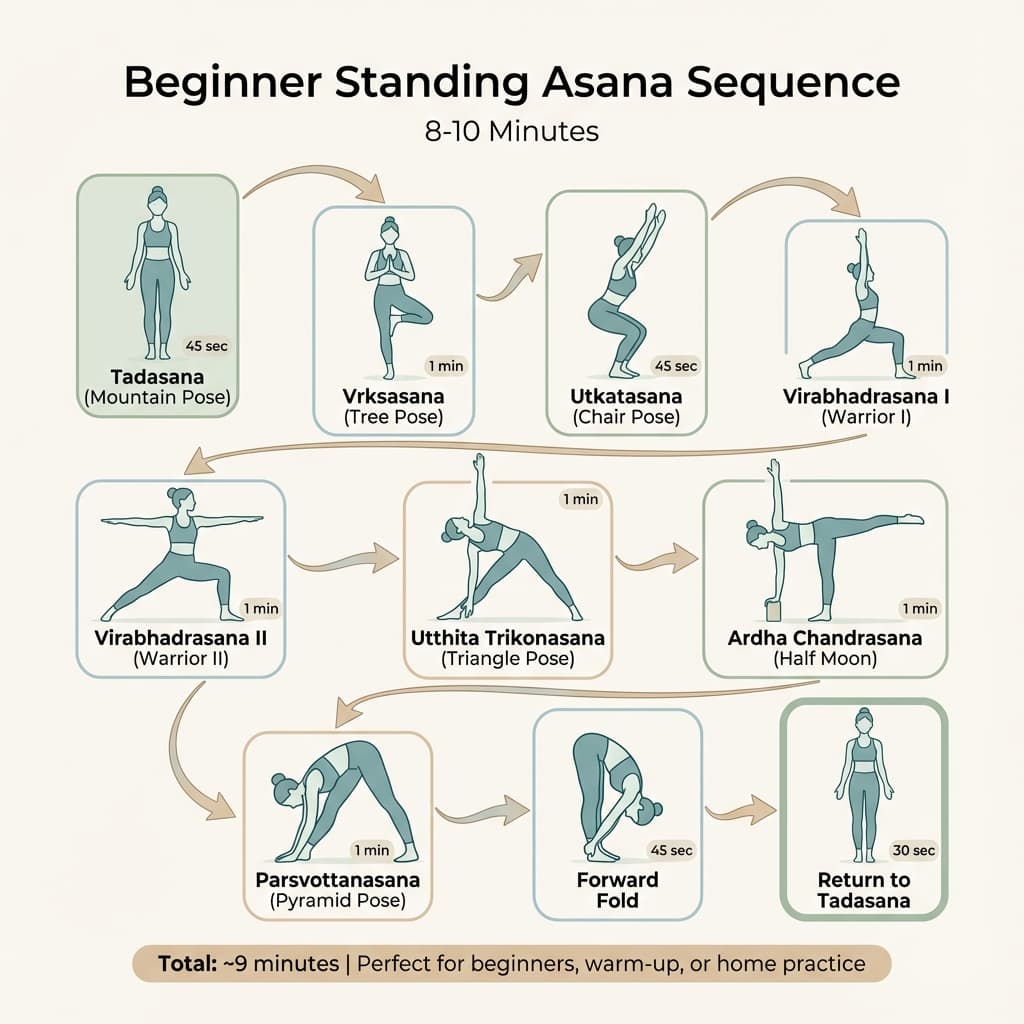
1. Tāḍāsana (Mountain Pose)
Duration: 45 secondsHow:
- Stand with feet hip-width apart
- Ground evenly through both feet
- Lift spine tall, relax shoulders
- Breathe slow and deep
Purpose: Creates alignment and centers the mind.
2. Vṛkṣāsana (Tree Pose)
Duration: 1 minute (30 sec each side)How:
- Shift weight onto one leg
- Place foot on opposite calf or inner thigh
- Hands in prayer at chest
- Soft gaze
Purpose: Improves balance and focus.
3. Utkaṭāsana (Chair Pose)
Duration: 45 secondsHow:
- Bend knees as if sitting in a chair
- Keep knees behind toes
- Lift chest, arms up
- Weight on heels
Purpose: Strengthens thighs, glutes, and core.
4. Vīrabhadrāsana I (Warrior I)
Duration: 1 minute (30 sec each side)How:
- Step one foot back
- Front knee bent, back leg strong
- Hips turn forward gently
- Arms overhead
Purpose: Builds leg strength, opens chest.
5. Vīrabhadrāsana II (Warrior II)
Duration: 1 minute (30 sec each side)How:
- From Warrior I, open hips and arms to the side
- Gaze over front fingertips
- Keep spine tall
Purpose: Improves stamina and hip stability.
6. Utthita Trikoṇāsana (Triangle Pose)
Duration: 1 minute (30 sec each side)How:
- Straighten front leg
- Slide torso forward
- Hand on shin/block
- Top arm up
Purpose: Deep side stretch, improves mobility.
7. Ardha Chandrāsana (Half Moon)
Duration: 1 minute (30 sec each side)How:
- From Triangle, bend front knee
- Place hand on floor/block
- Lift back leg
- Rotate chest open
Purpose: Enhances balance and core activation.
8. Parśvottānāsana (Pyramid Pose)
Duration: 1 minute (30 sec each side)How:
- Step into short triangle stance
- Fold forward over front leg
- Keep both legs straight
Purpose: Stretches hamstrings/calves, calms mind.
9. Cooling Down — Gentle Forward Fold
Duration: 45 secondsHow:
- Feet hip-width
- Soften knees
- Let head, neck, arms hang
- Slow breaths
Purpose: Releases lower back and tension.
10. Return to Tāḍāsana (Mountain)
Duration: 30 secondsHow:
- Stand tall
- Hands at chest
- Observe breath
Purpose: Integrates the entire sequence.
Total Time: ~9 minutes
Perfect length for:
- Beginners
- Warm-up routine
- Workplace / home short session
- Pre-meditation grounding
Safety & Modifications
- Those with knee or hip issues should shorten the stance and avoid deep bending.
- Use a chair or wall for balance in Tree, Half Moon and similar poses.
- In case of high blood pressure or cardiac conditions, avoid holding the arms overhead for long; take frequent breaks.
- Always come out of each pose slowly and with control, returning to Tadasana to feel the effects.